

Listen to the Podcast:
In this episode, I share 7 rules for thinking about paying off debt or investing for teachers.
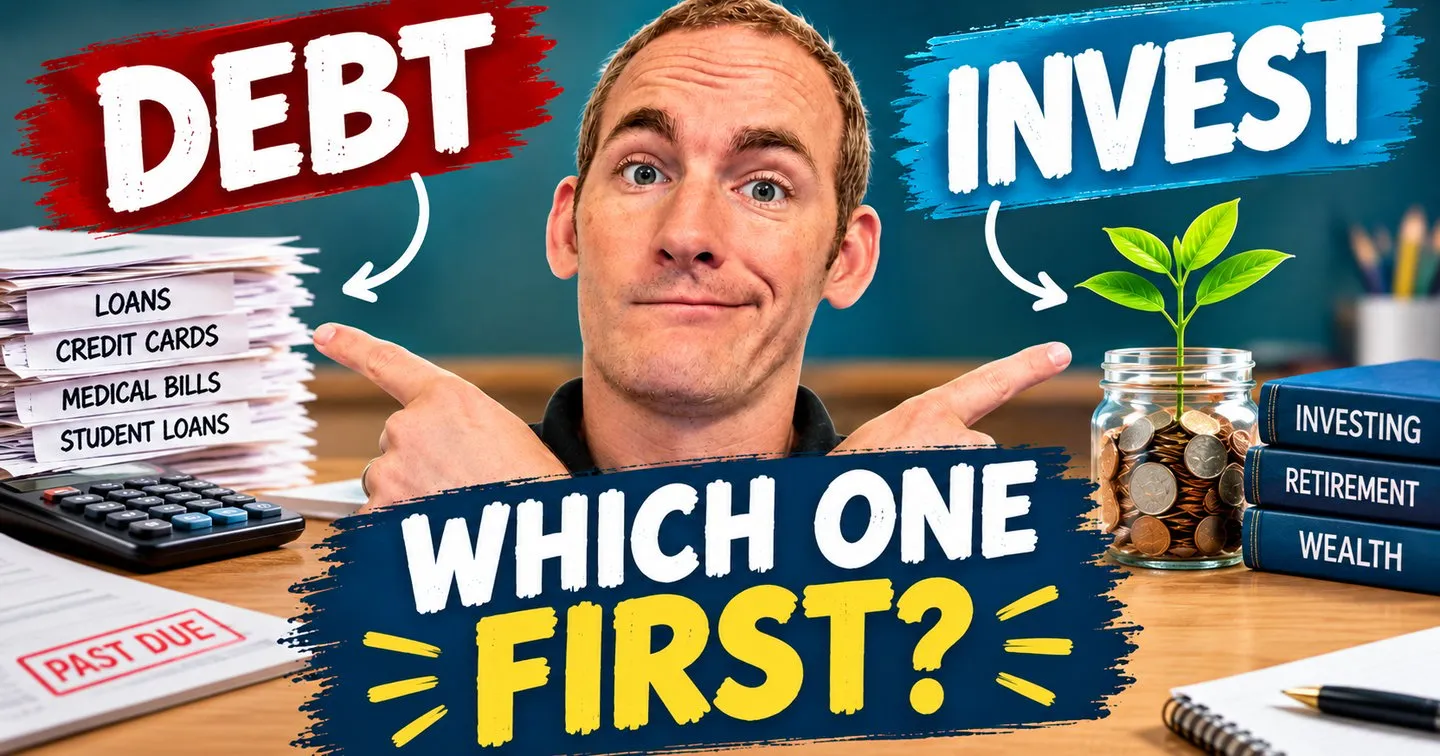
There is a fierce debate ongoing about whether you should invest first or pay off debt first. The thing is, life is rarely that black and white. If you have debt, of course, you need to be paying it off. If you have a future (all of us), of course you need to be investing for it. So, it isn’t so much a matter of either or, but of how to balance the two. In today’s episode I walk you through exactly how I think about this balancing act and choosing which to prioritize.
Show Notes
The Teacher's Roadmap to Financial Confidence — a free five-question worksheet for teachers who want greater financial confidence
This workbook will help you understand where you are with your debt and your investments, check it out!
Student loan question? Talk to my friend David Gourley: https://www.k-12planning.com/student-loans-1
Recommended Books (Amazon Affiliate Links)
A Teacher's Net Worth Book
Key Ideas
The decision is often more emotional than mathematical
You shouldn't completely ignore either debt or investing
Retiring with debt can dramatically increase the amount you'll need in retirement
The 4% rule changes when you eliminate expenses
Turn your debt snowball into an investing snowball
Teachers pursuing student loan forgiveness may want to approach debt differently
Use automatic investing to keep building wealth
Financial freedom requires more than simply maximizing the numbers
You must determine the right balance between debt payoff and investing for your situation
Bonus Tip
Here is a bonus tip I didn't get to in the episode.
Another interesting factor is “How the market is doing.” While I’m not a fan of using emotions when investing in the stock market, I think this emotion is valid. If we don’t feel confident that the stock market will continue to grow, it can be hard to invest, which can cause delays and mathematically poor decisions like dollar cost averaging (I’ll have to talk about that another time). So if you are unsure about the market, pay off debt! That is a guaranteed return and it drastically reduces your interest payments with each extra dollar you contribute.
Transcript
Should Teachers Pay Off Debt or Invest?
This transcript has been lightly edited for clarity and readability. Filler words, repeated phrases, and obvious transcription errors have been removed while preserving Shaun’s conversational style and the substance of the episode.
The Question: Pay Off Debt or Invest?
Should teachers pay off debt or invest? That is the question we're answering today. By the end of this episode, you will know whether debt payoff or investing is the right course for you. I'm Shaun Morgan, host of The Teacher Money Show, full time educator and money nerd who is building wealth on a teacher's salary. If I can do it, so can you.
So if you're a teacher looking for the financial confidence to reach your money goals and live a richer life, you are in the right place. If you like what you hear today, Please remember to subscribe and share it with a teacher friend. Now let's get started. OK. So what we are doing is talking about debt versus investing.
So like are we going to get out of debt? Are we going to invest that money? If I have $100 to do something with what is the best choice? And as with all of our good questions answers, it depends. But there's a few things we can keep in mind as we are considering whether or not we should pay off debt first or invest that money first.
I think the thing to remember first and foremost is it's not a wrong choice either way. You are making a good choice by not ignoring these things. Too many people ignore debt. They ignore investing for the future. So if you are doing either paying off debt or investing, you are making a good choice. You might not be making the best choice, but if that is what you're doing and you are unsure and you're paralyzed, just choose one.
Flip a coin for all I care. Just get started because either way you are contributing to your net worth by reducing your debt or increasing your assets. So both of them are a positive motion forward for you. Paying off debt is really powerful because it reduces your expenses, though. When you have less debt, you have a larger gap between your regular commitments and your income.
People don't think about this when they get into debt. They think, oh, I can get what I want now and then I'll just pay smaller amounts later. But as as you compound that, those smaller amounts get bigger and bigger and bigger and then you have a smaller amount of space to work in outside of those constraints of the minimum you must pay every single month.
So that is the problem with debt that we're trying by paying it off, we are reducing that monthly commitment, that regular payment every single time. Investing on the other hand, increases the money that you have to spend in retirement or whenever you need to start drawing on those funds. So they are they are exact opposites in a good way.
That reduces expenses. Investing increases the amount you have. So either way, you are getting closer to your goal. Now of course, you can't pay off debt your way to retirement, OK, You, you must have investments to be able to retire. You must have money coming in, but paying off debt makes it easier to retire.
So both of these things are essential. We need to figure out what is the best thing to prioritize for you. There are a few different ways that I think about this. I have seven ways of just processing the information that I'm going to share with you.
1. It’s Not Just a Math Problem
The first one is too many people think of this as a math problem. The first thing to do is jump into do I do the snowball, Do I do the avalanche? Do I do this? Do I do that? With the trying to optimize like $5 worth, that is not usually your problem. That's not usually what you need to figure out.
It's usually an emotional or security issue. Are you feeling insecure because you have too many debts? Are you feeling insecure because retirement's coming up and you don't have enough money set aside? Are you feeling motivated by putting money into an investment account or putting money into paying off your debts? Whatever pushes you forward emotionally, that is the best choice almost 100% of the time. Now, there does come a point where the math takes over. If you're investing S&P 500, you're getting that, you know, 10:00-ish percent return on investment historically, or you have 25% credit card debt.
The math kind of says get rid of that credit card debt now because there comes a point where it's just is so antithetical, so compounding in the negative that it just completely wipes away the benefits of investing. But if you have more of that regular, like I've got a 6% here and a 7% there and the 12% there and I've got my regular investments and I don't know what the best choice is.
That is when you need to consider the emotion of it more than the math of it. And most people are in that spot in a lot of ways. Now, the other way also works like if the debt is a very low percentage, if you have a mortgage at a 2 or 3% rate, then you know, the math does say that you need to invest. But there still might be a security factor that says, no, I want to pay off my mortgage.
So just keep in mind that how you feel does make a lot of difference. We don't want to make money so anti emotion that we try and force ourselves to do something that mechanically makes sense but actually is not going to help us succeed long term. So just keep that in mind. OK? The next thing to consider is
2. Never Ignore Debt Entirely
you shouldn't do just one. So my next two rules kind of go together #2 is never ignore debt entirely in favor of investing. Some people say, well, if you're going to get, you know, a higher return on your investments, always invest. Yeah, but you need to pay the minimums at least. And, you know, the every dollar you can spend extra on that just really tanks the amount of time you're going to be in debt.
So if you have a long debt pay down timeline, no matter how well you invested, if you are still going to be in debt, it can really just be a huge drag on your investments because you have this debt that you're going to have to take from your investments to pay off at some point because you haven't been paying it, you know, aggressively in any way.
So minimums definitely must be paid. Never ignore those. But putting more towards it back on the credit card, they charge like $50.00 a month for your minimum. Even $5 more than that is going to drastically reduce the amount of time that you are in credit card debt compared to paying the minimum. They build the minimum to be like a dollar or two higher than the amount that you would pay to never get out of debt.
That is how aggressive credit cards are on this. So just be careful with how you are are factoring these things. But I say never ignore debt in favor of investing. You ought to have a balance of both. It could be 10 percent, 90%, but we're always doing something towards debt. And then on the other hand, rule
3. Never Ignore Investing
3 is never ignore investing in favor of debt payoff. Now, this one might seem a little bit harder. It's like, well, you don't have to invest, right? Yeah, it's true. But ignoring investing does a few things. 1 it gets you in the habit of not investing. This is probably the biggest problem because you need to be in the habit of investing for it to be a, just a part of your life. And, and if you have money that's like automatically being invested, then it's, it's out of sight, out of mind. It just is going to be
happening, you know, right out of your paycheck into like, you know, a, a good 403(b) or a 457 or something like that. That money you don't have to think about. It's going to continue to start growing and compounding. And if you don't do that, once you've paid off debt, it can be really hard to then adjust into investing.
So you don't have that muscle being built automatically. Making adjustments is easier than starting from scratch. Also, there's just something about investing early, like it just compounds differently the longer it's in there. I don't know how to explain it mathematically. It doesn't seem to make sense in my brain. But you know, you invest, you invest, you invest and then it just explodes. Now I think that's because when you have money invested, you are there, you're in it long haul.
So when you have those explosive moments where the market just increases rapidly, you're in it, right. If, if you wait to invest until after you've gotten out of debt, you're going to have these moments of explosive growth that you just miss because you weren't invested along the way. So once again, it could be 90% on one side, 10% on the other, but being in and being in that investment space, even if debt payoff is a bigger deal to you, is very important.
So never ignore debt or investment. You got to keep doing both. You just are weighing it one way or the other when you're making this your consideration.
4. If You Can Help It, Never Retire in Debt
The fourth rule that I consider is, if you can help it, never retire in debt. So I'm leaning a little bit more toward debt payoff because debt generally has a heavier emotional baggage than investing does. So having that gone is a huge emotional relief, right? And when you are in debt, when you retire, it has a huge impact on your ability to retire and your funds because once again, you have that money that you must pay every single month.
I want you to consider this, that when you're in debt, it's going to artificially raise the amount of money you need to put into that 4% rule to have that money coming out. So like I have, you know, a mortgage and let's say that mortgage is costing me about $20,000 a year. Yours might be higher, might be lower, but that's about where where I'm at here here in Texas that mortgage because of how much it's costing me even though it's not on a huge amount of money, it's just you know mortgage.
So they have you pay in chunks that are the same over time would require me to have $500,000 invested to be able to cover that expense every month in retirement. But when I get out of the, the, the, the mortgage and I'm not paying anymore, yes, I'll still have my insurance and my taxes.
So I won't go down, you know, the full amount. But let's say that we can cut that in half to 250,000. Well, the amount of money that I'm putting into my, my mortgage payment, the, OR to pay it off, the amount of money that I'd put in to pay it off is less than that 250,000 that I would need to pay or the that $250,000 extra I'd need to have to cover my mortgage, if that makes sense.
So to, to recap this, it's kind of confusing idea. I have $500,000 invested to cover my, you know, $20,000 a year. Once I've paid off the mortgage, it goes down. Let's say it's now only $10,000 a year to cover my taxes and insurance, which is actually really high for me, but that's beside the point.
You have then that 500,000 goes to 250,000, right? So it just, it drops drastically the amount of money that I would need to put aside, but the amount of money I have to put into my mortgage to pay it off is actually less than that $250,000 drop. So the point is that if you can pay off a debt that has a high amount of money that you have to set aside every single month to pay it, the amount of swing that you would of like the amount of money that you'd need
if you were in debt versus the amount of money you'd need now that you're out of debt is usually more drastic than the amount of money it takes to pay off the debt because of that 4% multiplier. What does that mean? Well, the 4% rule basically means for every dollar you spend, you need $25 in retirement funds.
So if I can remove a dollar of spending, I can remove $25 from my investment accounts and still be fine, right. So just having that, that swing has that 25 time multiple against what I'm paying off. It's just a very, very powerful effect to pay off debt before you retire. So never retire in debt if you can help it, whatever it takes.
Even if you have to sell some of your investments, you'll probably end up better off by selling some investments, paying off your debt, and then retiring versus staying in debt for another 5–15 years in retirement and making it work on just the amount you can pull out every single month from your
5. Turn Your Debt Snowball Into an Investing Snowball
investments. OK #5 your debt snowball becomes your investing snowball. I don't care if you're using the avalanche or the snowball or whatever frozen water analogy you want. The point is that you have this money that's crushing your debt, right? You have all these minimum payments. You pay off 1. You take the minimum payment from that one and you put it plus the extra principal you're paying to the next one plus that minimum payment.
Then then you, you know, stack those on the next one and then the next one. And once you get to the end, people can get really excited and they're like, I've got all this money now I'm going to go celebrate. And that causes problems. Instead what you do is you just say I am used to living in a place where I have, you know, 1,000–2,000 or whatever dollars a month going toward my debt. I can take a step back a little bit because it'd be nice to, you know, be able to breathe.
But instead of taking that whole 2000 and saying I can spend it now you take that whole, you know, 2000, you take a little bit in to give you breathing room and say $1500 now goes in towards your investment. So you just continue to roll that debt snowball into now a investing snowball.
That's that way you continue to use that money for improving and increasing your net worth instead of now spending it frivolously on things that you don't really need usually. So I think this is just a powerful strategy to keep in mind as you are crushing that debt, that money, because of what you're doing with it and making it a net worth booster is your investment booster as well.
Just take that money and out of sight, out of mind, right? Once you hit that, that debt is paid off moment, you know I would Jack up those retirement investments because that money is going to come out before you even get to touch it. You won't be tempted as much to touch it if it just goes right out of your paycheck. Set up automatic withdrawals with you. Know that IRA, whatever it takes to get money flowing somewhere else.
Set an automatic contribution to your taxable brokerage account.. However it is that you are investing, make it automatic. Make it money that it's out of sight, out of mind. I love being able to like split your paycheck in this so you can be like, you know what, now that I'm done paying off my debts, or even before you could probably do this, you can have like a chunk of your money. Go to a separate bank account.
Make that your debt payoff bank account. Make that you're investing bank account. So that way it never even hits your main spending account. So that way you're always putting that money into a place where it will be going towards improving your net worth and making it so that you're covered in retirement.
6. Consider Student Loan Forgiveness
OK. Number six, if you're in teaching for the long haul, I would prioritize investing over paying extra on student loans if you have loan forgiveness coming, unless your rate is too high. Now, what do I mean by that? Well, if you have, you know, a 10-year window to get, you know, a great loan forgiveness package and you've got a lot of debt, I'm not talking about like, you know, $10,000 of debt. It probably makes more sense to just pay that off instead of how much you're going to pay an interest over the course of those ten years on that 10,000.
As they break it into those smaller chunks, especially if they're having you pay, you know, a little bit and then it's like growing and growing and growing. You have this huge interest rates that are coming up and then things can happen there. But if you have a huge amount that you have to pay as a teacher, you know, you might want to consider just investing because that is going to go away. If you continue teaching.
If you're struggling and you're not sure you're going to continue teaching, then maybe this is not the best strategy. But if you're like, no, teaching is my life. I'm going to continue teaching. I've got the whole 10 years in me. I can do this. It's a good strategy to let that forgiveness come in so that way you can prioritize investing and have that compound and grow.
Now, I want to say that this is just my opinion.. I have not had student loans. I've not had to go the loan forgiveness track. Once again, emotions trump this. That was, that was rule #1 so if you're like, I just can't do it. I got to get out of debt, then get out of debt.
But this is just a way to think about the, the you have the benefit of the forgiveness coming and every dollar you put into your debt payoff on that loan forgiveness. It is great if it gets paid off early, but if you put all this money into it and then it gets forgiven, well you could have just not put all that money into it.
It would have all been forgiven anyway, and then you could have invested that money instead. So just keep that in mind. This is a very touchy subject though, so I highly recommend you talk to an advisor about this. In the show notes for this show, I will put some links to advisors because I've got a couple of great friends who are advisors specifically on student loans and, and they can help you out. So you can go to teachermoneyshow.com/podcast. You can also just find all the stuff in the description for this video or podcast if you're
in your podcast player, and you'll be able to get those those links directly there. So that way you can get the help
7. Be Free
you need making this decision. And then #7 in general, I lean toward debt payoff over investing, not because you can't get a higher return on investing, but because it feels better to be debt-free. OK. I've been in both places. I've been debt-free. And then I made some mistakes and ended up in debt, not consumer debt. I've talked about this.
It was investing debt that because the investment went bad. But it's not fun to be in debt. It was a lot more fun to be debt free. It was a lot more beautiful feeling every day to be like, I don't owe anybody anything. Half the purpose of financial freedom is to feel free financial freedom. There's two pieces, the financial piece and the free piece.
And if you are doing things that are getting you unfree because you want the financial benefit, you're missing the mark. It is impossible to feel free while in debt. It is impossible to feel free while in debt, so make sure that you are making the right decisions about this and are getting yourself to a spot of freedom and not a spot of servitude to a bank or to a lender of some kind.
This is just my hobby horse right now. I believe debt should be destroyed. We need to find a way that doesn't involve debt now. Are there uses for debt? Absolutely. I'm not going to say never get debt. I'm, I'm not Dave Ramsey, but I am saying that debt should only be touched in the same way you're touching, you know, a burning hot red poker at a distance only for the proper use. You don't want to get burned.
You've got to be very careful with it. And in general, being debt-free what's going to make you feel free and ready to retire. So those are my 7 rules.
Recap: The 7 Rules
Just to recap them. It's an emotional problem, not a math problem. So make sure you use your emotions to guide you and less the math is overwhelming #2 Never ignore debt entirely in favor of investing #3. Never ignore investment in favor of debt payoff #4 Never retire in debt. It's going to really wreck your 4% rule #5 Use your debt snowball to become an A debt become an investing snowball. Number six, if you are in teaching for the long haul, then use that loan forgiveness so you can invest more and then #7. Be free, make the decisions that
will make you free. So all of this comes down to
Putting It Into Practice
understanding where you're at. Where are you with your debt? Where are you with your investments? It's really important that you get a handle on this. You need to do a debt inventory where you list out here are the debts, how much I owe, monthly payments, the interest rates. Here are my investments, how much I have my current return on investment. What am I expecting to get over the next, you know, 10, 20, or 30 years?
And once you've got that, once you know where you are, you can decide using these ideas where you want to put your money. Either way, make paying off debt or investing in a top priority. No matter what you choose, you have to decide how much you're going to contribute and stick with it.
Say, this is how much I want to put towards my net worth and do not back down. And in fact, I'd say push it until you feel the pain. OK, One of my favorite quotes from the financial Samurai. I haven't listened to a lot of the stuff, but he said if you are not saving or paying off that or investing whatever you want to say until it hurts, you're not doing enough. Right there is that point when you can't go any further and that is the place that you're playing with because you are trying to get out of debt,
you're trying to get free. Do not be lackadaisical about this. Contribute a certain amount and stick with it. If you are able to pull that money out, say no. This money is 100% for debt, it's 100% for investing. I am not going to touch it. That puts a constraint on you, constraint on your finances, a constraint on what you can and cannot do, and it forces you then to be creative. It is actually a beautiful, beautiful thing because you can't just throw money at it because you've committed that money to something else.
You have to say, OK, I want this thing, I want to do this. This needs to happen. I've got to make that happen. Now what am I going to do about it? Instead of saying I got the money, you say, how am I going to solve this problem? You become creative, you become entrepreneurial. Entrepreneurship, in my opinion, is just about solving problems. And you go out there and you make something happen instead of just throwing money at it.
And this is a powerful thing. So the more you can actually live within a constraint, the more you can move that needle forward to creating a richer life to help you with your debt inventory and your investments and then deciding where you're at so you can make that decision of how much I'm going to put aside and what am I going to do? Leaning more debt, leaning more
The Teacher’s Roadmap to Financial Confidence
investments. I recommend you check out the Teacher's Roadmap to financial confidence. This document has two steps built into question five that will bring you the financial clarity on your debt and your investments. So that way you can make these decisions. So that can be found by going to teachermoneyshow.com/roadmap and you'll be able to answer all the questions. They're all great questions.
But specifically for this episode, question 5 is what just gives you that picture of where you're at. So go to teachermoneyshow.com/roadmap and that way you can get that clarity on your debt investments to make the right choice. And as you go about this, as you
Make the Decision That Moves You Forward
are deciding, do I need to pay off debt? Do I need to invest? What am I going to do to move my net worth forward to become more free? Just remember that as a teacher, you are already rich. Your wallet just needs to catch up. If you're a teacher who loves teaching but aren't sure if you can reach your financial goals, I've created a free worksheet called the Teacher's Roadmap to Financial Confidence.
Go to TeacherMoneyShow.com/roadmap to get your copy. That's teacher moneyshow.com road map.
Disclaimer
The contents of this podcast are informational in nature and are not legal or tax advice, and neither I nor my guests are engaged in the provision of legal, tax or any other advice. You should not act upon this information without first seeking appropriate advice from an accountant, financial planner, lawyer, or other professional.